The machinery behind every fill
From the first tick ingested to the order acknowledgement coming back, each layer of the stack is tuned for the same thing: acting on a good read before the edge disappears.
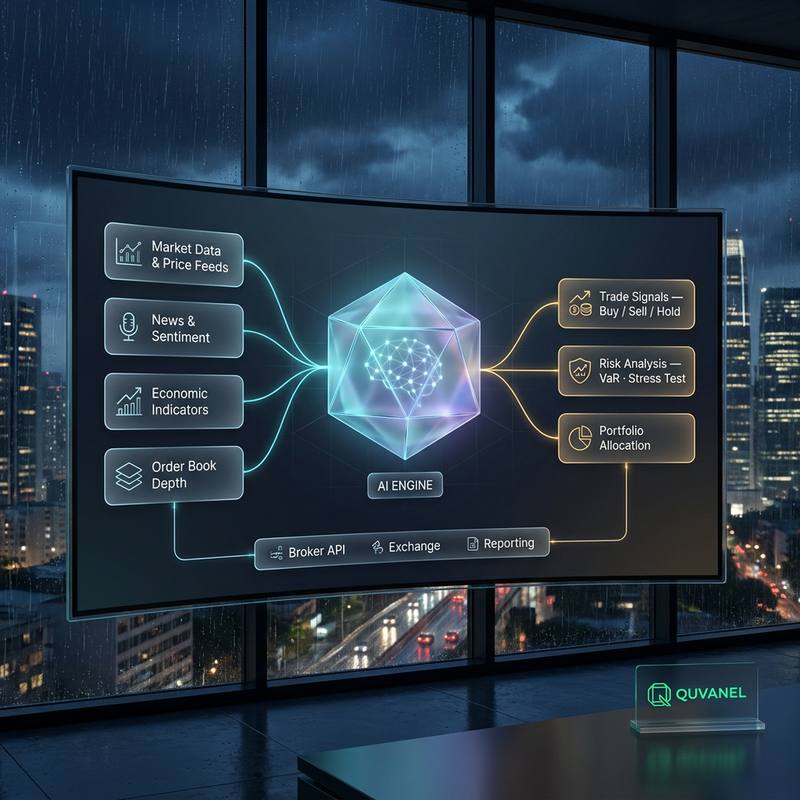
Reading a market before it moves
The engine ingests price history, order-book depth, newsflow sentiment and macroeconomic releases, then runs them through models that are retrained on every completed market cycle rather than frozen at launch.
What comes out is a ranked list of signals, each carrying a confidence score, a sizing recommendation and explicit invalidation levels — all settled before a single order leaves the building.
Four ways to hold a position
Enable them individually or together. Each one can be switched off from your console without closing the account.
Staged accumulation
Splits a target position across a support band so one badly timed entry cannot define the whole trade.
Band harvesting
Works range-bound conditions, collecting the repeated swings between a mapped floor and ceiling.
Momentum reallocation
Moves weight toward whichever assets are showing genuine relative strength, and away from the ones stalling.
Drawdown guard
Tightens exposure step by step as an adverse move develops, so a losing run is contained instead of compounded.
Latency budget
Matching infrastructure colocated beside the venues we route to holds the average round trip at 3.1 milliseconds.
Full audit trail
Every order records the model that raised it, the inputs that justified it and the level that closed it.

Security in layers, not slogans
Encryption in transit and at rest, mandatory two-factor sign-in, and granular approvals on every withdrawal or change to your account profile.
The large majority of digital assets stay offline in cold storage, and the infrastructure goes through external penetration testing and independent review on a quarterly cycle.
Run the engine
on your own book
Adaptive prediction, hands-off operation and institutional-grade custody in one Canadian account.
Open Account